12 Best Pellet Smokers and Grills for Backyard Cooking
The short answer
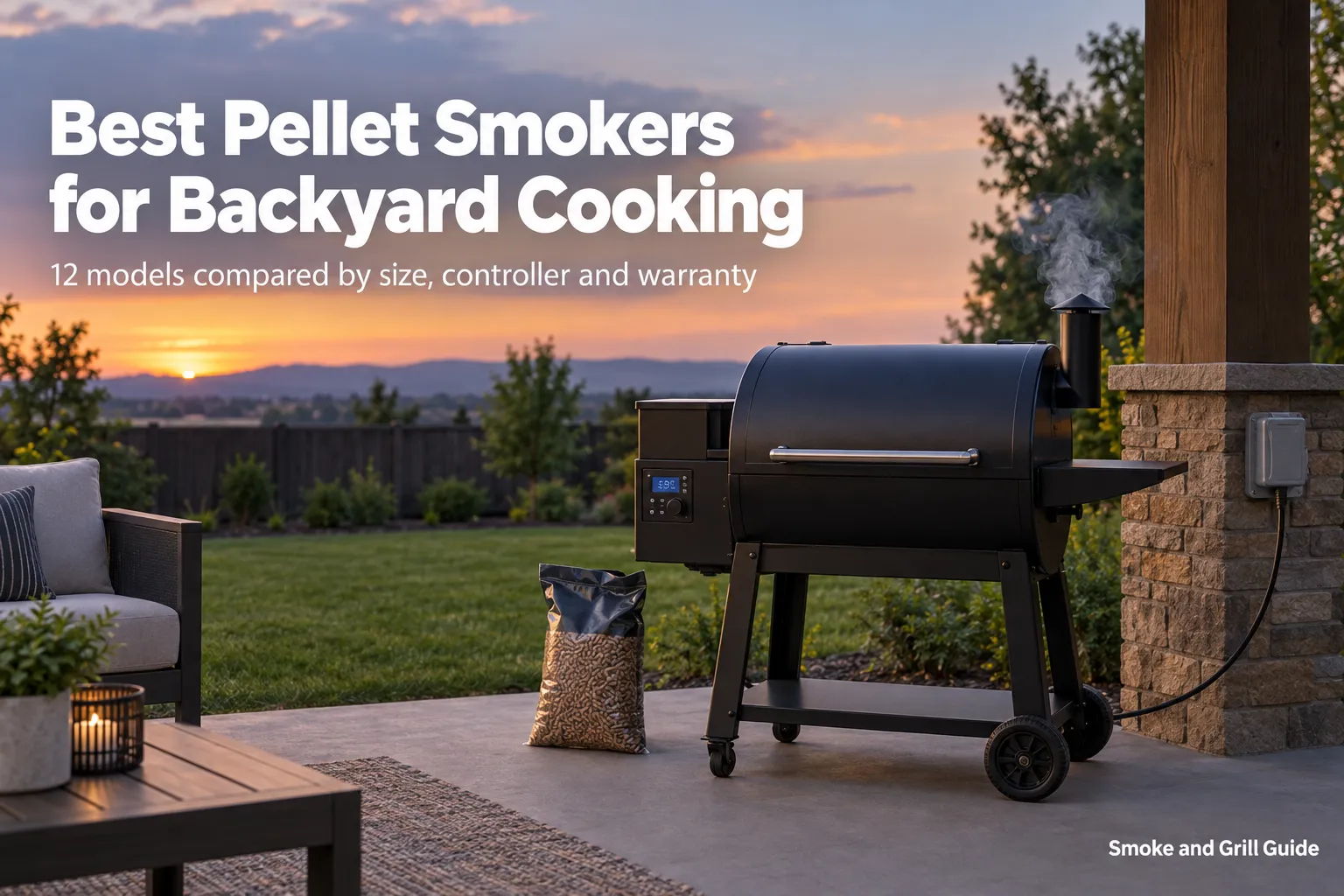
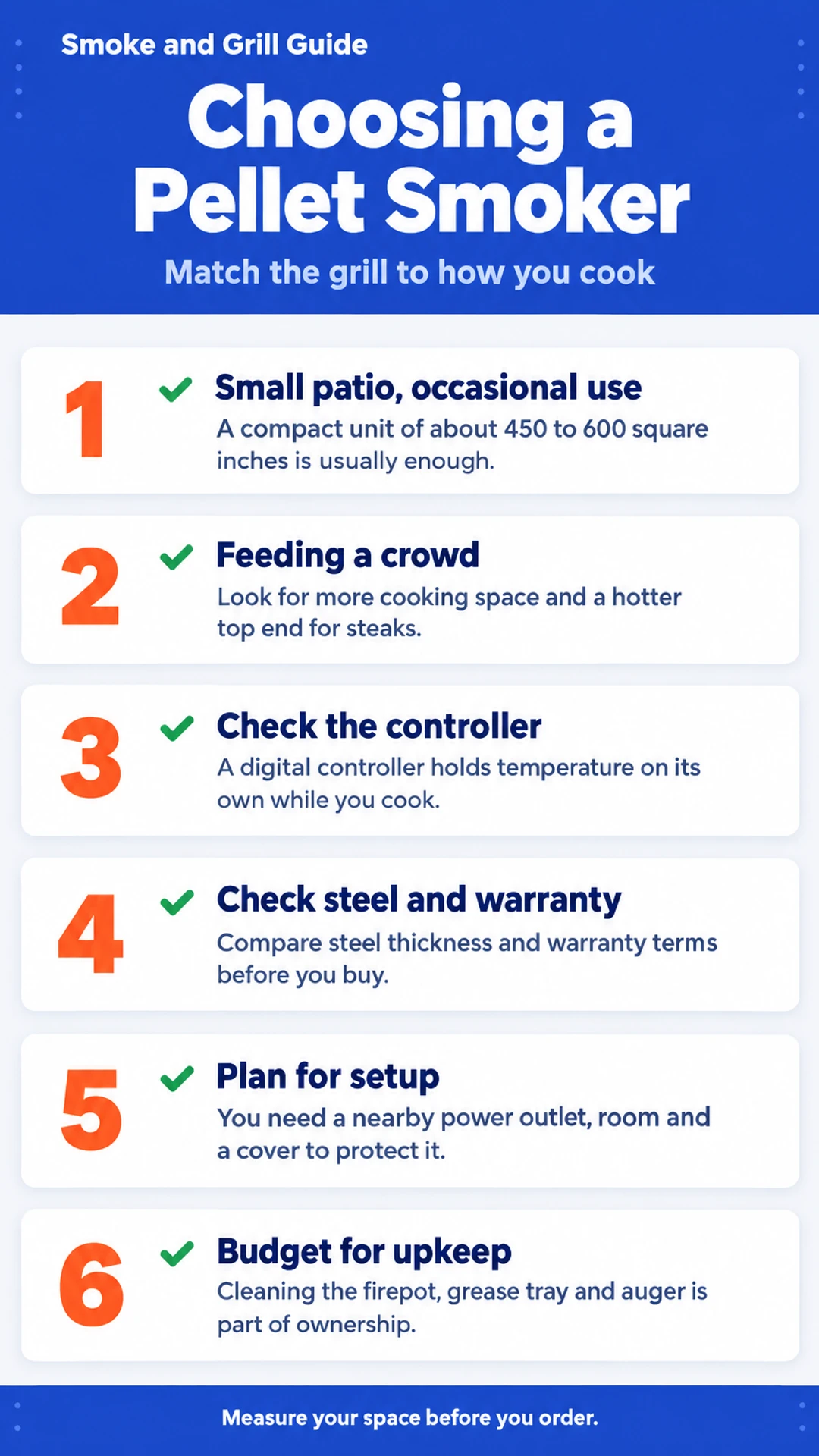
The best pellet smoker depends on how you cook. For a small patio and occasional smoking, a compact unit around 450 to 600 square inches is usually enough. For feeding a crowd or grilling steaks at high heat, look for more cooking space and a hotter top end. Check the controller, the steel thickness, the warranty and whether you have a nearby power outlet and cover. This guide compares 12 models by those factors.
Some links on this site are affiliate links: if you buy through one, the site may earn a commission at no extra cost to you. More about this.
Most people who buy a pellet grill want smoked flavor without tending a fire for hours. They also want a digital controller that holds temperature on its own, and often one machine that can grill, smoke, bake and roast. If you are replacing an aging gas or charcoal grill, that versatility is usually the main reason to switch.
Before you buy, it helps to be honest about the tradeoffs. Pellets cost more to run than charcoal in many cases, the unit needs an outlet, and it needs room and cover to last. Cleaning the firepot, grease tray and auger is part of ownership, and parts and support vary a lot between brands.
We picked the 12 pellet smokers and grills in this guide by comparing published specifications, cooking space, steel thickness, controller type, warranty terms and what the makers say each model does well. We also drew on hands-on reviews by other people, credited where they appear. We have not tested these grills ourselves, so we say what is known from specs and reviews and what is not.
Let's dive in.
Best pellet smokers at a glance
| Option | Best for | Size or portability | Key feature | Price as stated |
|---|---|---|---|---|
| Pit Boss 850 DX | Families and entertaining | Largest cooking area in its comparison | Smoke output a little above average | Not stated |
| Traeger Pro 22 | Simple barbecue smoking | Not stated | Well-known brand, no Wi-Fi | Not stated |
| Recteq RT-B380 Bullseye | Higher-heat grilling and charring | Not stated | PID control, about 800 F on Riot mode | Not stated |
| Weber SmokeFire XL | Heavy smoke and premium build | 157 lb, lighter than the Yoder | Strong smoke output | Higher-priced |
| Yoder YS640S | Heavy-duty build and direct grilling | 418 lb, very heavy | 1/8 inch chamber steel, 500 F griddle | Not stated |
| Pit Boss Pro Series 1600 | Large cooking area for the money | 1600 sq in across three levels | 14 gauge steel, more features | Lower than Traeger 780 |
| Traeger 780 | Two or three people, brand name | 780 sq in on two levels | Trusted name and wide parts base | Changes often, check current |
| Weber Searwood | One grill for grilling and smoking | Not stated | Cast aluminum bottom chamber | Not stated |
Guides on this site
A closer look at each
Pit Boss 850 DX: Strong space and value for families and entertaining. The DX 850 has the most cooking area of the grills in the Smoked BBQ Source comparison, which the reviewer said feels bigger than the rest of the series and has room for feeding a family or a crowd. Its smoke output was a little above average, and the reviewer found its smoky flavor decent for barbecue, though grilling above the flame broiler is limited. Check the app connection and chamber temperature swings before you buy.
Traeger Pro 22: Simple barbecue smoking and brand trust. The Pro 22 is a good fit if you mainly want to smoke ribs, pork shoulder and brisket with few extras. In Smoked BBQ Source's test, it still produced a good medium smoke level for barbecue, but it was weaker on steak and has no Wi-Fi or added features. Buyers who value a well-known brand with a long track record often start here.
Recteq RT-B380 Bullseye: Higher-heat grilling and charring. The Bullseye is PID controlled and held about 275 degrees with some fluctuation in Smoked BBQ Source's test. On Riot mode it reached about 800 degrees, which the reviewer used for charring chicken wings. Clean out ash and grease first. The reviewer also had the drip pan and heat deflector catch fire, so a pan under protein on low and slow cooks is worth doing.
Weber SmokeFire XL: Heavy smoke output and a premium build. In David Gafford's review of the Yoder YS640S, the SmokeFire XL was compared with the Yoder on smoke output, with both described as among the smokiest grills he has tested. It weighs 157 lb, much lighter than the Yoder at 418 lb, so it is easier to move. It is a higher-priced option aimed at buyers who want a premium build and strong smoke.
Yoder YS640S: Heavy-duty build and strong direct grilling. The Yoder is very heavy at 418 lb, and its cooking chamber steel is noticeably thick at 1/8 inch. In The Barbecue Lab's review, four quarter-pound burgers cooked at once over the wide burn trough on the pullout panel, and reverse-seared ribeyes on the 500 F griddle got a strong sear in about 60 seconds per side. Price and weight make it a hard sell for most home cooks.
Pit Boss Pro Series 1600: Large cooking area and solid steel for the money. The 1600 gives 1600 square inches of cooking space across three levels, against 780 on two levels for the Traeger 780 in Dead Broke BBQ's comparison. Rick, who has used it for nine months, found the 14 gauge steel feels solid, and he picked it over the Traeger 780 for more features at a lower price. Its size needs a good deal of outdoor room and a power outlet nearby.
Traeger 780: A smaller, brand-name option for light use. The Traeger 780 has 780 square inches of cooking space on two levels, which is enough for a rack of ribs or a couple of chickens but tight for a large brisket. Reviewer Rick of Dead Broke BBQ, who has used it for about a month, found its middle and top racks cramped for large cuts. The brand has a wide parts and support base, and the grill suits a buyer who cooks for two or three people and wants a pellet grill with trusted name recognition. Check the current price before you buy, since it changes often.
Weber Searwood: Versatile cooking beyond smoking. The Searwood is built for more than low-and-slow work. Its cast aluminum bottom chamber will not rust, and it supports grilling, griddle cooking, rotisserie and smoking. The Smoked BBQ Source reviewer noted its smoke and heat flexibility, though they did not cover its long-term durability. It fits a buyer who wants one pellet grill for weeknight burgers and weekend brisket. Expect to clean the firepot and grease tray regularly, as with any pellet grill, and confirm the price at the time you shop.
Camp Chef Woodwind Pro: A mid-range option with a good amount of cooking space. The Woodwind Pro sits in the middle of the price range and offers a fair amount of room for a backyard cook. It is a sensible step up for someone moving from a basic model who wants more capacity without jumping to a premium price. Pellet grills in this class generally include a digital controller, which lets you set a temperature and walk away. I have not run this grill myself, so check the cooking area dimensions against your typical load before buying.
Z Grills Multitasker 1068: Large cooking area with Wi-Fi control. The Multitasker 1068 pairs a large cooking surface with Wi-Fi control, so you can watch and adjust the temperature from your phone. That suits cooks who host often and do not want to stand by the grill all afternoon. Large grills need more space, a level spot and a power outlet within reach, so plan the placement before you order. Wi-Fi connection quality varies with your home network, so test it early.
KingChii 456 sq in Pellet Grill Smoker: A compact, lower-priced unit for a small patio. At 456 square inches, this is one of the smaller units in the list. It fits a small patio or balcony where a full-size grill would crowd the space. It is a practical choice for one or two people cooking a few pounds of meat at a time. Expect less room for multiple racks or a large batch, and keep it covered or under a shelter, since most pellet grills are not built to sit in rain.
VEVOR 8-in-1 Wood Pellet Grill Smoker: A budget multi-function option. The VEVOR is a budget pick that advertises eight cooking functions, which covers grilling, smoking, baking and roasting. Those functions are the vendor's claim, and the results will depend on how well each mode holds temperature in practice. Budget pellet grills usually mean fewer premium features and thinner steel, so the tradeoffs are real. It is worth a look if you want to test whether pellet cooking suits you before spending more. For a wider look at what a lower budget gets you, see our guide to the best budget pellet smoker under $500.
What hands-on reviewers found
These are other people's hands-on tests, summarised and credited to them. Watch the full videos for their complete reviews.
The Barbecue Lab: Is This The Best Pellet Smoker On The Market? | Yoder YS640s Review
David Gafford thinks the Yoder YS640S is a very well built, smoky, American-made grill with excellent direct grilling and searing ability, though its price and weight make it a hard sell for most buyers and it is not an obvious pick over co
- The grill weighs 418 lb, far heavier than the Weber SmokeFire XL at 157 lb. The 1/8 inch cooking chamber steel is noticeably thick. (at 0:51)
- Biscuits baked evenly across the grate at 375 F, with consistent doneness from one side to the other. (at 6:20)
- The pullout panel allowed direct grilling over the wide burn trough, and four quarter-pound burgers cooked at once. This is better than small burn cup grills. (at 9:00)
- Reverse-seared ribeyes on the griddle at 500 F produced a strong sear in about 60 seconds per side. (at 10:30)
Smoked BBQ Source: I Retested the Best Budget Pellet Grills in 2026 – The Market Has Changed
The reviewer thinks the Pit Boss DX 850 is the best of the Pit Boss DX series for space and value, the Traeger Pro 22 suits buyers who want simple barbecue smoking and brand trust, the Recteq Bullseye is strongest for high-heat grilling, an
- The DX 850 feels bigger than the other models and has the most square inches of cooking space of the grills covered, enough room for entertaining and feeding a family. (at 1:07)
- The reviewer found the DX's smoke output a tad above average and everything barbecue-related had a decent smoky flavor, though grilling capacity above the flame broiler is limited. (at 2:08)
- The reviewer disliked the Pit Boss app, which took too long to connect to the phone, and found temperature swings and left-to-right discrepancies in the chamber that required rotating food. (at 2:50)
- On the Traeger Pro 22, the reviewer found it still smokes barbecue well, with a good medium smoke level, though it is weaker for steak and has no Wi-Fi or extra features. (at 3:51)
Dead Broke BBQ: Pit Boss Vs Traeger Pellet Grill | Which One Should You Buy
Rick thinks the Pit Boss Pro Series 1600 is the clear winner over the Traeger 780 because it offers more and better features for less money.
- Rick has used the Pit Boss 1600 for nine months and the Traeger 780 for the past month, cooking low and slow and grilling on both. (at 0:01)
- The Pit Boss 1600 has 1600 square inches of cooking space on three levels, while the Traeger 780 has 780 square inches on two levels; the middle and top racks are tight for large cuts like brisket. (at 0:59)
- The Pit Boss 1600 is made of 14 gauge steel and feels solid, while the Traeger 780 uses 16 gauge steel. Both pits have sturdy legs that stay stable when moved. (at 3:07)
- Rick found the Pit Boss 1600's porcelain-coated cast iron grates hard to clean and shifting when moved, and preferred the Traeger's standard wire grate. (at 5:21)
Fatty Butts BBQ: Lone Star Grillz 20x42 Review | Best Pellet Smoker Yet?
Fatty Butts BBQ thinks the Lone Star Grillz 20x42 is a top-tier pellet smoker that comes close to offset-style smoke flavor, with solid build, reliable performance on an overnight brisket, and worthwhile features, though the off-road packag
- The reviewer ran an overnight brisket cook burning pellets, wood chips and an oak split, and reported the pellet and chip feed ran all night with no issues and the augur worked reliably. (at 0:01)
- Smoke flavor on the brisket was judged very strong and probably one of the best the reviewer has had from a pellet grill, with a beautiful smoke ring and juicy meat. (at 14:55)
- The Fireboard app stayed connected throughout the cook, letting the reviewer watch the whole cook remotely, and temperature swings were about plus or minus 5 to 10 degrees, typical for pellet grills. (at 14:55)
- The reviewer found the built-in thermometer read about 212 degrees, matching the Fireboard reading, and noted the steel holds heat well once up to temperature. (at 10:48)
Frequently asked questions
How much does it cost to run a pellet smoker compared with charcoal or gas?
A pellet grill burns hardwood pellets, usually about 1 to 2 pounds an hour at typical smoking temperatures, and a 20 pound bag of pellets costs roughly the same as a bag of charcoal. Running cost depends on how long you cook and how hot. Gas is often cheaper per hour for quick grilling, while pellets trade a little fuel cost for steady, low-effort smoking.
Do I need an outlet and cover for a pellet smoker?
Yes. Pellet grills use an electric auger to feed pellets and a fan to run the fire, so they need a standard 120 volt outlet nearby, and a standard household outlet is the usual requirement. Most owners keep them under a cover or in a sheltered spot, because moisture can ruin pellets and rust the firepot and body over time.
How much space do I need for a pellet grill?
Plan for clearance on all sides, typically at least a few inches from walls and more near the back and vents, and room to open the lid fully. Cooking area ranges from about 500 square inches on compact models to over 1,000 on large ones, so match the size to how many people you usually cook for.
How much maintenance does a pellet smoker need?
Routine care is a grease tray cleanup after most long cooks, a firepot vacuum every few cooks, and a periodic check of the auger and ash. Manufacturers' manuals list the exact schedule, and keeping the firepot and grease tray clear is what prevents most fire-starting and temperature problems.
Does a pellet smoker taste as good as wood or charcoal smoking?
Pellet smokers produce a clean, mild smoke that suits poultry, pork and brisket well. Some people find the flavor a little lighter than a stick-burning offset smoker, and the flavor depends on the wood type you choose. Many buyers accept that tradeoff for the steady temperature and hands-off cooking.
Wrapping up
This guide covers 12 pellet smokers and grills, each matched to a different kind of cook.
Look at space, power and cover needs before you compare features.
Which one will you try first, or which one did we miss?